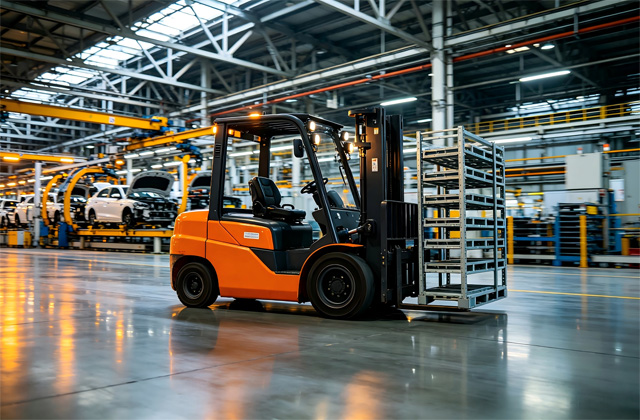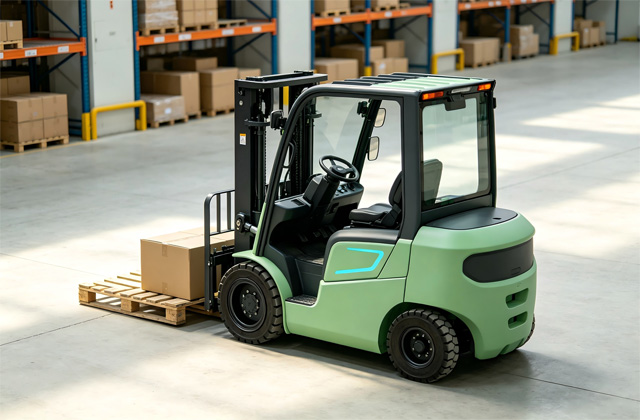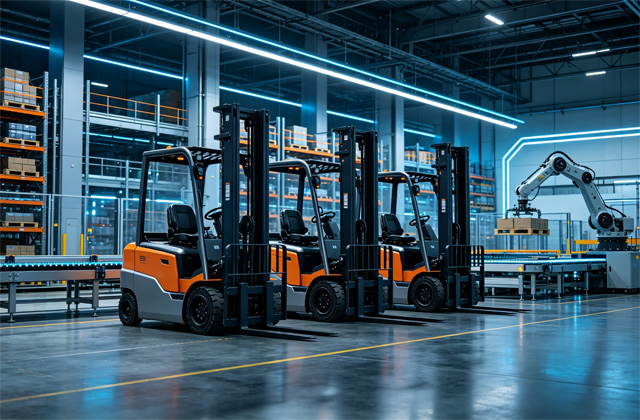
In warehouses, factories, ports, and logistics parks, forklifts operate silently yet frequently. Unlike cars, they aren't repeatedly showcased, nor are they hotly debated, but they are irreplaceable basic equipment in the modern industrial system. What truly determines a forklift's reliability, efficiency, and ability to withstand high-intensity operations is not its surface-level parameters, but the forklift manufacturer behind it.
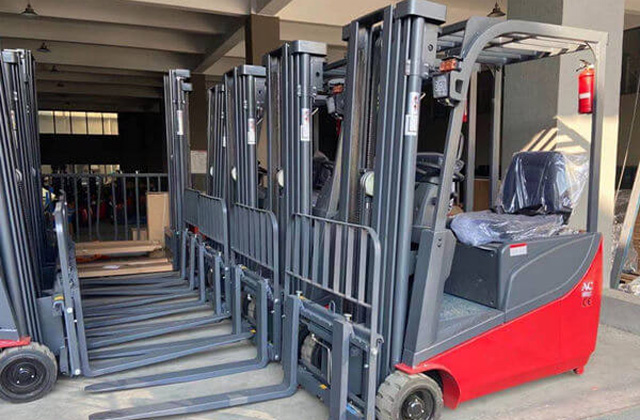
I. The Essence of Forklift Production: A Concrete Expression of Industrial Efficiency
Many people understand forklift production only at the level of "steel + engine + tires," but in actual manufacturing, forklifts are more like a highly systematic industrial solution.
1. From "Being Able to Move Goods" to "Efficiently Moving Goods"
Early forklifts had only one core objective: to lift goods and move them elsewhere. But today, forklift manufacturers face the following more complex needs:
Completing more handling operations per unit time
Maintaining stability and precision in confined spaces
Performance without performance degradation during long-term continuous operation
Reducing operator fatigue
Adapting to various working conditions and load variations
This means that the production logic of forklifts has upgraded from "mechanical manufacturing" to efficiency engineering. 2. The "Hidden Value" of Industrial Equipment
A well-designed forklift often brings several changes to a company after three months of use:
* Significantly improved warehouse turnover speed
* Reduced pressure on manual dispatching
* Lower equipment failure rate
* More controllable maintenance costs
These changes are the "hidden value" embedded by the forklift manufacturer during the design phase.
II. Key Aspects of Forklift Production Determine Everything
Forklifts may seem simple in structure, but every key aspect of the production process directly impacts the final quality.
1. Frame and Structure: The Underlying Logic of Stability
The frame is the "skeleton" of the forklift. Excellent forklift manufacturers typically focus on three points in frame design:
* Overall center of gravity layout: Ensuring stability under full load, turning, and braking
* Consistent welding processes: Avoiding stress concentration after long-term use
* Material selection: Different tonnage uses different strength steels
Experienced manufacturers don't blindly pursue "thickness," but rather maximize structural efficiency.
2. Power System: Not Just a "Horsepower" Indicator
Whether it's an internal combustion forklift or an electric forklift, the power system is the core.
Internal combustion forklifts focus on: power output curves, fuel consumption control, and heat dissipation efficiency. Electric forklifts focus on: motor response speed, battery management system, and energy recovery. Truly mature forklift manufacturers often tailor their power systems for different operating conditions, rather than offering a one-size-fits-all solution.
3. Hydraulic System: The Key to Ease of Use
Many users report forklifts as "clumsy," "slow," and "unresponsive," but the problem often lies not in the engine, but in the hydraulic system:
* Is the hydraulic pump properly matched?
* Is the multi-way valve response linear?
* Are lifting and tilting smooth?
* During the production phase, hydraulic system tuning is a highly experience-intensive task and a crucial standard distinguishing ordinary manufacturers from professional forklift manufacturers.
III. The Difference Between Forklift Manufacturers Often Lies in the Details
* What truly differentiates forklift manufacturers is never the specifications in brochures, but rather the often overlooked details.
1. Operational Comfort is Not an "Add-on"
Excellent forklift manufacturers consider the operator's actual experience during the design phase:
Seat shock absorption structure
Pedal height and angle
Yield travel
Blind spot optimization
Because they understand that forklifts are not "occasional equipment," but production tools used for more than 8 hours a day.
2. Maintenance Logic Reflects Manufacturing Mindset
Whether a forklift is "easy to maintain" is determined during the production stage:
Key components are easy to disassemble
Daily maintenance points are centralized
Consistent wear parts are standardized
Professional forklift manufacturers treat maintenance as part of the product lifecycle, not just the after-sales department's responsibility.
IV. Shuangchao Machinery: Understanding Forklift Value from the Manufacturing Source
Among many forklift manufacturers, Shuangchao Machinery consistently adheres to a clear direction:
Not pursuing short-term configuration stacking, but focusing on the manufacturing logic of long-term stable operation.
1. Product Design Guided by Actual Working Conditions
Shuangchao Machinery places great emphasis on the differences in different usage scenarios during forklift production:
Factory workshops
Warehouse logistics
Building materials markets
Complex outdoor road conditions
Each scenario has different requirements for forklifts. Shuangchao Machinery doesn't simply copy models; instead, it optimizes them specifically in terms of structure, power, and configuration.
2. Manufacturing Standards Throughout the Entire Process
From raw material selection and core component matching to complete vehicle assembly and factory testing, Shuangchao Machinery consistently adheres to:
Strict tolerance control in key areas
Multiple inspections of important welding points
Real-world performance testing of the entire vehicle, not just paper compliance.
This manufacturing philosophy ensures that forklifts maintain stable performance even under long-term, high-intensity use.
3. Focus on "Performance After Ten Years"
Shuangchao Machinery doesn't just consider "the moment of delivery," but focuses on:
Stability after three years
Management costs after five years
Safety margins for long-term use.
This long-term perspective is a key characteristic of professional forklift manufacturers.
V. Development Trends in Forklift Production: Manufacturing is Changing
With industrial upgrading, forklift production is also undergoing significant changes.
1. Electrification is More Than Just Energy Replacement
The widespread adoption of electric forklifts is not merely a matter of "battery replacement," but a complete system restructuring:
* More intelligent control systems
* More refined energy management
* Changing maintenance models
Forklift manufacturers must possess cross-domain capabilities to truly excel in electrified products.
2. Rapidly Growing Customization Needs
More and more companies are realizing:
* Standard forklift ≠ Optimal forklift
Therefore, forklift manufacturers, the ability to customize is becoming a core competitive advantage.
3. Continuously Rising Safety Standards
From structural safety to operational safety, forklift safety requirements are constantly increasing, posing higher barriers to manufacturers' design, testing, and verification capabilities.
VI. How to Determine if a Forklift Manufacturer is Worth Partnering With
For buyers, when choosing a forklift manufacturer, consider the following:
* Does the manufacturer truly understand your usage scenario?
* Does the manufacturer possess a stable manufacturing system?
* Can the product withstand long-term testing?
* Is the manufacturer willing to invest in details?
Shuangchao Machinery has won increasing recognition from users precisely because of its understanding of the essence of manufacturing and its commitment to long-term value.