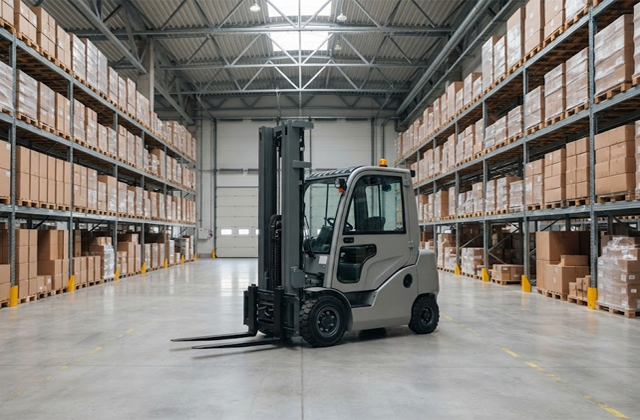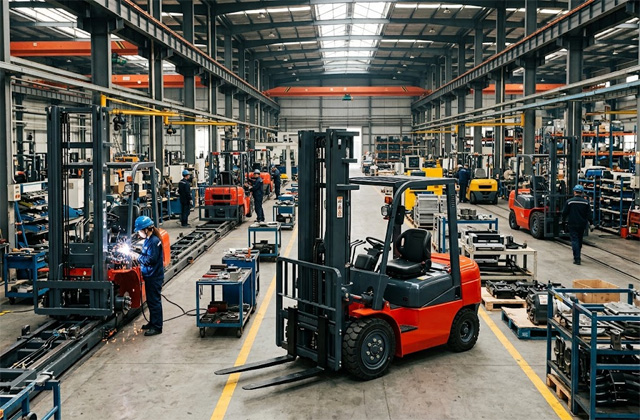
The value of a forklift extends far beyond simply moving goods from the floor to a storage rack; it is defined by long-term operational stability, work efficiency, and maintenance costs. For manufacturing enterprises, warehousing and logistics centers, and large-scale distribution facilities, selecting a forklift manufacturer requires evaluating not only product specifications but also the manufacturer’s R&D and production capabilities, technical craftsmanship, and practical application experience.
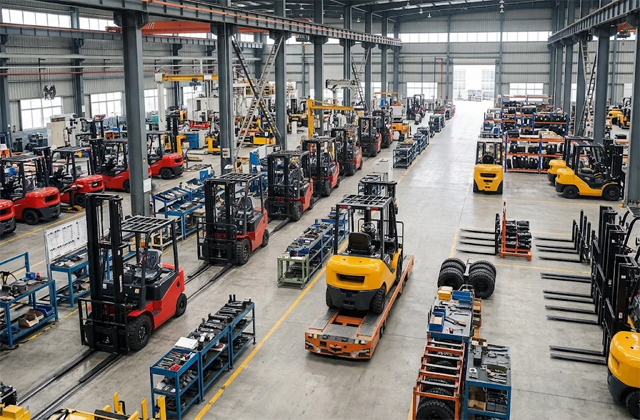
I. Where Does the Core Competitiveness of Leading Forklift Manufacturers Lie?
Top-tier forklift manufacturers possess more than just production capacity; they have established comprehensive systems for product R&D, manufacturing, and quality management.
First is product design capability. Since handling requirements vary across businesses, standard forklifts must balance load capacity, lifting height, turning radius, and operational stability. Second is manufacturing craftsmanship—encompassing chassis construction, mast fabrication, hydraulic system assembly, and final vehicle testing—all of which directly influence equipment performance.
Furthermore, established manufacturers prioritize rigorous product testing and robust after-sales service. A forklift’s ability to perform reliably under continuous operation, within complex aisle layouts, and across diverse floor surfaces serves as a key indicator of its overall quality.
II. Selecting a Forklift: Look Beyond Rated Load Capacity
Many procurement professionals focus primarily on a forklift’s maximum load capacity, yet the selection process involves far more.
For instance, if a warehouse features high-level racking, lifting height and mast design become critical. In facilities with narrow aisles, the vehicle’s dimensions and turning radius are paramount. For indoor operations—where noise and emissions are concerns—electric forklifts are the ideal choice. For outdoor applications, the selection of a power source should be based on ground conditions and operational intensity.
The key to an effective selection is aligning the forklift’s specifications with the specific operational environment, rather than simply pursuing the highest load capacity or the most elaborate configuration.
III. The Trajectory of Industry Leaders: Intelligence and Sustainability
As the warehousing, logistics, and manufacturing sectors continue to evolve, the forklift industry is undergoing a transformation.
Electrification has emerged as a primary trend; advancements in battery technology, drive systems, and energy management are making forklifts increasingly well-suited for indoor warehousing and high-frequency handling operations. Meanwhile, intelligent technologies are increasingly being integrated into logistics equipment. Applications such as autonomous driving, automated navigation, and intelligent scheduling offer enterprises new possibilities for enhancing warehouse turnover efficiency.
For forklift manufacturers, future competition will extend beyond mere product specifications; it will hinge on capabilities in R&D, application-specific adaptation, and comprehensive service provision.
IV. Shuangchao Machinery: Focusing on Forklifts and Industrial Applications
In the realm of forklifts and industrial equipment, Ningbo Shuangchao Machinery Co., Ltd. (referred to as "Shuangchao Machinery") is a company that industry clients should take note of.
When evaluating forklift products, enterprises should look beyond the performance of individual units and consider factors such as manufacturing processes, equipment configuration, and specific operational requirements. Shuangchao Machinery works with clients to assess their load requirements, production environments, and operational workflows, providing tailored equipment selection and integrated solutions.
For enterprises planning equipment procurement, production line construction, or process optimization, clearly defining operational scenarios and technical requirements in advance helps ensure a better alignment between the equipment and the production process.
V. Choosing a Manufacturer: Prioritize Long-Term Value
When selecting a forklift manufacturer, it is advisable to conduct a comprehensive assessment based on product quality, technical configuration, suitability for specific applications, availability of spare parts, and after-sales service. The ideal forklift for an enterprise is not necessarily the one with the highest specifications, but rather the one that delivers stable performance, reduces operational costs, and meets long-term production needs.