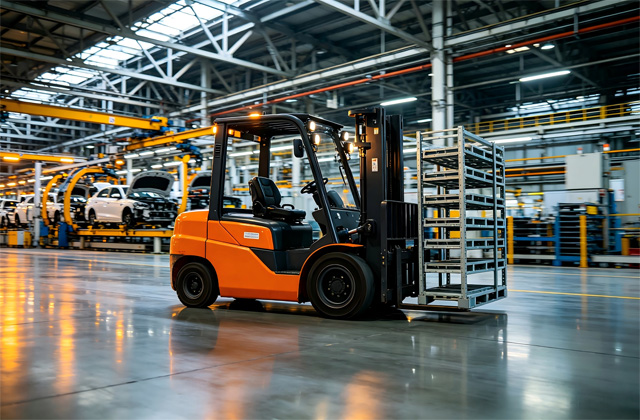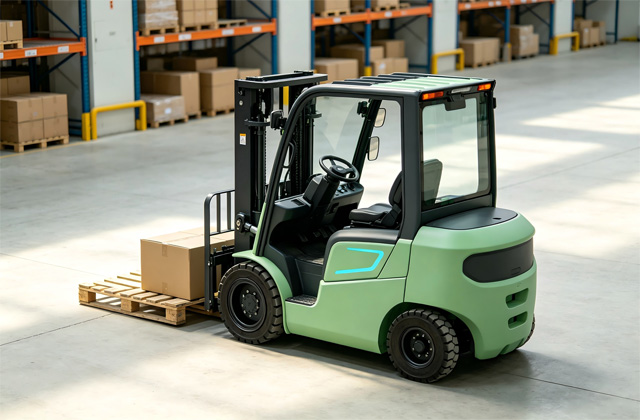
When many people look at a forklift, their first focus is on load capacity, mast height, engine specifications, or battery capacity. However, for those truly knowledgeable about manufacturing, a forklift's competitiveness is often determined long before it is even assembled.
A forklift undergoes numerous manufacturing stages—from steel cutting, structural welding, and surface treatment to final assembly, hydraulic system testing, and comprehensive machine inspection. Leading forklift manufacturers do not rely merely on a single piece of advanced equipment; instead, they integrate every detail through a cohesive system of production lines, manufacturing processes, quality management, and testing protocols.
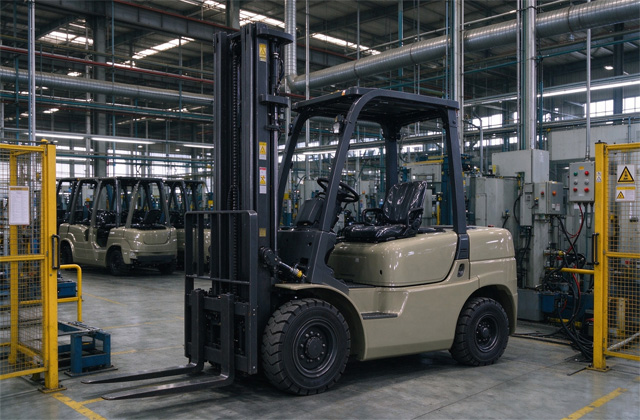
The forklift production line: the first test is the ability to manufacture the "skeleton"
The chassis and the mast are among the most critical components of a forklift.
These vehicles face repetitive operational demands daily—lifting, transporting, steering, and braking. Consequently, structural components must possess sufficient strength without simply adding excessive weight through the indiscriminate use of materials. Therefore, the quality of processes at the start of the production line—such as steel cutting, bending, stamping, and welding—is crucial.
The mast, in particular, bears the direct load during the lifting process. Precision in weld placement, dimensional stability, and the absence of deformation at key connection points all directly impact subsequent assembly and the vehicle's overall operational performance.
Leading manufacturers do not view structural component production merely as a machining step; instead, they establish quality control checkpoints centered on process consistency. In other words, a specific part produced today should maintain the same dimensional accuracy and assembly reference points as one produced next month.
This is why, when evaluating a forklift manufacturer, one should look beyond the size of the factory or the number of machines; the true measure is the ability to keep manufacturing tolerances within reasonable limits.
From welding to painting: every process step influences the vehicle's lifespan
Forklifts are quintessential industrial equipment, often operating in harsh environments.
Warehouses, factories, logistics parks, shipping terminals, and construction sites all place different demands on vehicle durability. After welding, structural components must undergo grinding, surface treatment, and painting.
There is a commonly overlooked point here: visual appearance is not synonymous with coating quality.
A vibrant color is merely the most visible attribute; what truly matters is the adequacy of surface preparation, the stability of coating adhesion, and the consistency maintained throughout the production process. A mature forklift manufacturing system integrates stages such as pre-treatment, painting, and drying into a comprehensive quality control process. The purpose of this is not merely to make the forklift "look new," but to ensure the metal structure receives durable surface protection for long-term operation.
Final assembly is more than just "putting parts together."
It is during the final assembly stage that the forklift truly takes shape as a fully functional system.
Components such as the engine (or battery and motor), drive axle, steering system, braking system, hydraulic system, mast, forks, and electrical control units must all be matched according to design specifications.
This is particularly critical for electric forklifts, where the battery, motor, and controller require precise matching; internal combustion forklifts involve the integration of the engine, transmission system, and cooling system. The GB/T 43756-2024 standard further details design requirements across these various systems—power, transmission, steering, braking, hydraulics, and electrical.
Consequently, the competitive edge of leading forklift manufacturers often lies in "system synergy."
For instance, even among forklifts with similar rated capacities, differences in the matching of the drive system, hydraulic system, and overall vehicle configuration can lead to variations in driving experience, lifting response, energy consumption, and operational efficiency.
This explains why forklift production lines increasingly emphasize modular and standardized assembly.
"Invisible" testing stages also play a decisive role in setting manufacturers apart.
The completion of assembly does not mark the end of production.
Comprehensive vehicle testing often serves as the final, crucial checkpoint on the production line.
Testing protocols cover aspects such as lifting, steering, braking, hydraulics, electrical systems, and overall operational status. Stability is paramount for forklifts, as the vehicle is subject to variables like load weight, center of gravity, and lifting height during material handling.
The GB/T 43756-2024 standard specifically addresses overall vehicle stability, as well as the calculation and verification of structural components such as the mast, forks, and chassis.
Therefore, a truly capable forklift manufacturer must establish a closed-loop process that encompasses design, machining, assembly, and testing, rather than focusing on just one stage. The value of a production line lies in ensuring the closest possible alignment between the "designed forklift" and the "finally delivered forklift."
Why are more and more enterprises focusing on forklift production equipment?
For forklift manufacturers, increasing production capacity involves more than just adding workers.
If processes such as cutting, welding, painting, and assembly continue to rely heavily on manual expertise as production scales up, product consistency and production efficiency are likely to suffer.
Consequently, forklift production lines are evolving toward automation, digitalization, and flexible manufacturing.
For instance, in the production of structural components, processing efficiency can be boosted through high-efficiency blanking and welding equipment; in assembly, workstation planning can minimize repetitive handling; and in inspection, data logging and process traceability make it easier to pinpoint issues.
For forklift enterprises of varying sizes, a production line need not necessarily be "massive and all-encompassing." A more rational approach is to configure the line based on product type, output volume, process characteristics, and factory conditions.
This is a crucial factor when selecting a supplier for forklift production equipment: ensuring the equipment suits your specific production system is far more important than simply focusing on the quantity of machines.
Shuangchao Machinery: Serving Forklift Manufacturing Through Production Equipment
In the realm of forklift production equipment, Shuangchao Machinery focuses specifically on the production processes that underpin forklift manufacturing.
Ningbo Shuangchao Machinery Co., Ltd. caters to the manufacturing needs of forklifts and related industrial equipment, providing services centered on production equipment, manufacturing processes, and production line construction. For enterprises planning to expand production lines, optimize existing processes, or upgrade equipment, production machinery should not be viewed as isolated purchases; rather, decisions must integrate processing workflows, production cycle times, and actual product structures.
In practical projects, key questions to consider include: Where is the biggest bottleneck in the current production line? Which processes are suitable for automation? How are the machines interconnected? Is there room to adjust the production line if product models change in the future?
Effectively addressing these issues ensures that equipment investment translates into genuine gains in production efficiency.
Shuangchao Machinery continues to provide technical services focused on forklift production equipment and manufacturing processes. We help enterprises look beyond the purchase of individual machines to consider the entire production workflow, fostering a more rational synergy between equipment and processes. For companies looking to build or upgrade forklift production lines, this approach—grounded in actual production needs—offers far greater value than a simple comparison of technical specifications. When evaluating a manufacturer of forklift production lines, focus on these five key points:
If a company is seeking a supplier for forklift production lines or manufacturing equipment, it should prioritize the following aspects:
First, consider industry experience.
Does the supplier truly understand forklift structure, welding, assembly, and production processes, rather than simply providing generic equipment?
Second, assess process compatibility.
Can the equipment integrate into existing production workflows, or would it require extensive modification?
Third, evaluate production line flexibility.
Can the equipment remain usable if the company introduces new models, changes production volumes, or adjusts its product mix in the future?
Fourth, examine quality control.
Are there clear checkpoints for machining, assembly, and inspection, and is production data traceable?
Fifth, look at service capabilities.
Does the supplier offer a comprehensive service chain covering everything from solution design and equipment manufacturing to installation, commissioning, and ongoing maintenance?
A high-quality production line must ultimately answer one fundamental question.
Forklift manufacturing may appear to be about producing vehicles, but in reality, it is about establishing a stable industrial capability.
It is not difficult for a single forklift to perform well occasionally; the challenge lies in maintaining structural precision, assembly quality, and performance stability during mass production. A truly mature forklift production line ensures that every process step is grounded in established standards, every critical point undergoes inspection, and equipment, processes, and personnel work together efficiently.
Therefore, when selecting a manufacturer, rather than simply asking "How much does the equipment cost?", a company should first ask: "Can this production line truly solve my manufacturing challenges?"
From individual machines to complete production lines, and from mechanical machining to intelligent manufacturing, competition in the forklift industry is shifting from merely "building a vehicle" to "consistently building every vehicle well." This shift is precisely why leading forklift manufacturers continue to invest heavily in production processes and manufacturing systems.